When you haven't done something for a while it's often best not to rush straight back in at the intensity you were at before. So here's a nice easy blog to get me going again (not that I was blogging intensely before!).
I didn't blog about it at the time (unsurprisingly), but back in late June 2013 I went to visit a colleague of mine in Madrid, Dr Francisco Seijo. Francisco and I met back at something I did blog about, the 2009 US-IALE conference in Snowbird. Since then we've been discussing how we can use the idea of coupled-human and natural systems to investigate Mediterranean landscapes.
Example of Traditional Fire Knowledge. The ‘pile-burning’ technique involves raking, piling and igniting leaves. This contrasts with ‘a manta’ broadcast burning in which leaves and ground litter are burned across larger areas. Photos by the authors of the paper.
After a brief field visit by me, an interview campaign by Francisco, collection of secondary data from other sources (aerial photography and official fire statistics) and some desk analysis, we recently published our first paper on the work. Entitled Forgetting fire: Traditional fire knowledge in two chestnut forest ecosystems of the Iberian Peninsula and its implications for European fire management policy, and published in the journal Land Use Policy, the article presents the results of our mixed-methods and interdisciplinary approach. Building on Francisco's previous examination of 'pre-industrial anthropogenic fire regimes' we to to investigate differences between the fire regimes and management approaches of chestnut forest ecosystems in two municipalities in central Spain. In the paper we also discuss ideas of Traditional Ecological Knowledge (TEK), the related idea of Traditional Fire Knowledge (TFK), and discuss them in light of contemporary fire management approaches in Europe.
The full abstract is below with links to the paper. I'll stop here now as this rate of blogging it making me quite dizzy (but hopefully I'll be back for more soon).
----
Seijo, Francisco, James DA Millington, Robert Gray, Verónica Sanz, Jorge Lozano, Francisco García-Serrano, Gabriel Sangüesa-Barreda, and Jesús Julio Camarero (2015) Forgetting fire: Traditional fire knowledge in two chestnut forest ecosystems of the Iberian Peninsula and its implications for European fire management policy. Land Use Policy47 130-144. doi: 10.1016/j.landusepol.2015.03.006
[Online] [Pre-print]
Abstract
Human beings
have used fire as an ecosystem management tool for thousands of years. In the
context of the scientific and policy debate surrounding potential climate
change adaptation and mitigation strategies, the importance of the impact of
relatively recent state fire exclusion policies on fire regimes has been
debated. To provide empirical evidence to this ongoing debate we examine the
impacts of state fire exclusion policies in the chestnut forest ecosystems of
two geographically neighbouring municipalities in central Spain, Casillas and
Rozas de Puerto Real. Extending the concept of ‘Traditional Ecological
Knowledge’ to include the use of fire as a management tool as ‘Traditional Fire
Knowledge’ (TFK), we take a mixed-methods and interdisciplinary approach to
argue that currently observed differences between the municipalities are useful
for considering the characteristics of “pre-industrial anthropogenic fire
regimes” and their impact on chestnut forest ecosystems. We do this by
examining how responses from interviews and questionnaire surveys of local
inhabitants about TFK in the past and present correspond to the current
biophysical landscape state and recent fire activity (based on data from
dendrochronological analysis, aerial photography and official fire statistics).
We then discuss the broader implications of TFK decline for future fire
management policies across Europe particularly in light of the published
results of the EU sponsored FIRE PARADOX research project. In locations where
TFK-based “pre-industrial anthropogenic fire regimes” still exist, ecosystem
management strategies for adaptation and mitigation to climate change could be
conceivably implemented at a minimal economic and political cost to the state
by local communities that have both the TFK and the adequate social, economic
and cultural incentives to use it.
Key words
Fire exclusion policies; traditional ecological knowledge; traditional
fire knowledge; Chestnut forest ecosystems; FIRE PARADOX
Back in February last year I wrote a blog post describing my initial work using agent-based modelling to examine spatial patterns of school choice in some of London's education authorities. Right at the start of this month I presented a summary of the development of that work at the IGU 2013 Conference on Applied GIS and Spatial Modelling (see the slideshare presentation below). And then this week I had a full paper with all the detailed analysis accepted by JASSS - the Journal of Artificial Societies and Social Simulation. Good news!
One of the interesting things we show with the model, which was not readily at the outset of our investigation, is that parent agents with above average but not very high spatial mobility fail to get their child into their preferred school more frequently than other parents - including those with lower mobility. This is partly due to the differing aspirations of parents to move house to ensure they live in appropriate neighbourhoods, given the use of distance (from home to school) to ration places at popular schools. In future, when better informed by individual-level data and used in combination with scenarios of different education policies, our modelling approach will allow us to more rigorously investigate the consequences of education policy for inequalities in access to education.
I've pasted the abstract below and because JASSS is freely available online you'll be able to read the entire paper in a few months when it's officially published. Any questions before then, just zap me an email.
Millington, J.D.A., Butler, T. and Hamnett, C. (forthcoming) Aspiration, Attainment and Success: An agent-based model of distance-based school allocation Journal of Artificial Societies and Social Simulation
Abstract
In recent years, UK governments have implemented policies that emphasise the ability of parents to choose which school they wish their child to attend. Inherently spatial school-place allocation rules in many areas have produced a geography of inequality between parents that succeed and fail to get their child into preferred schools based upon where they live. We present an agent-based simulation model developed to investigate the implications of distance-based school-place allocation policies. We show how a simple, abstract model can generate patterns of school popularity, performance and spatial distribution of pupils which are similar to those observed in local education authorities in London, UK. The model represents ‘school’ and ‘parent’ agents. Parental ‘aspiration’ to send their child to the best performing school (as opposed to other criteria) is a primary parent agent attribute in the model. This aspiration attribute is used as a means to constrain the location and movement of parent agents within the modelled environment. Results indicate that these location and movement constraints are needed to generate empirical patterns, and that patterns are generated most closely and consistently when schools agents differ in their ability to increase pupil attainment. Analysis of model output for simulations using these mechanisms shows how parent agents with above-average – but not very high – aspiration fail to get their child a place at their preferred school more frequently than other parent agents. We highlight the kinds of alternative school-place allocation rules and education system policies the model can be used to investigate.
This week I visited one of my former PhD advisors, Prof John Wainwright, at Durham University. We've been working on a manuscript together for a while now and as it's stalled recently we thought it time we met up to re-inject some energy into it. The manuscript is a discussion piece about how agent-based modelling (ABM) can contribute to understanding and explanation in geography. We started talking about the idea in Pittsburgh in 2011 at a conference on the Epistemology of Modeling and Simulation. I searched through this blog to see where I'd mentioned the conference and manuscript before, but to my surprise, before this post I hadn't.
In our discussion of what we can learn through using ABM, John highlighted the work of Kurt Godel and his incompleteness theorems. Not knowing all that much about that stuff I've been ploughing my way through Douglas Hofstadter's tome 'Godel, Escher and Bach: An Eternal Golden Braid' - heavy going in places but very interesting. In particular, his discussion of the concept of recursion has taken my notice, as it's something I've been identifying elsewhere.
The general concept of recursion involved nesting, like Russian dolls, stories within stories (like in Don Quixote) and images within images:
Computer programmers of take advantage of recursion in their code, calling a given procedure from within that same procedure (hence their love of recursive acronyms like PHP [PHP Hypertext Processor]). An example of how this works is in Saura and Martinez-Millan's modified random clusters method for generating land cover patterns with given properties. I used this method in the simulation model I developed during my PhD and have re-coded the original algorithm for use in NetLogo [available online here]. In the code (below) the grow-cover_cluster procedure is called from within itself, allowing clusters of pixels to 'grow themselves'.
However, rather than get into the details of the use of recursion in programming, I want to highlight two other ways in which recursion is important in social activity and its simulation.
The first, is in how society (and social phenomena) has a recursive relationship with the people (and their activities) composing it. For example, Anthony Gidden's theory of structuration argues that the social structures (i.e., rules and resources) that constrain or prompt individuals' actions are also ultimately the result of those actions. Hence, there is a duality of structure which is:
"the essential recursiveness of social life, as constituted in social practices: structure is both medium and outcome of reproduction of practices. Structure enters simultaneously into the constitution of the agent and social practices, and 'exists' in the generating moments of this constitution". (p.5 Giddens 1979)
Another example comes from Andrew Sayer in his latest book 'Why Things Matter to People' which I'm also progressing through currently. One of Sayer's arguments is that we humans are "evaluative beings: we don't just think and interact but evaluate things". For Sayer, these day-to-day evaluations have a recursive relationship with the broader values that individuals hold, values being 'sedimented' valuations, "based on repeated particular experiences and valuations of actions, but [which also tend], recursively, to shape subsequent particular valuations of people and their actions". (p.26 Sayer 2011)
However, while recursion is often used in computer programming and has been suggested as playing a role in different social processes (like those above), its examination in social simulation and ABM has not been so prominent to date. This was a point made by Paul Thagard at the Pittsburgh epistemology conference. Here, it seems, is an opportunity for those seeking to use simulation methods to better understand social patterns and phenomena. For example, in an ABM how do the interactions between individual agents combine to produce structures which in turn influence future interactions between agents?
Second, it seems to me that there are potentially recursive processes surrounding any single simulation model. For if those we simulate should encounter the model in which they are represented (e.g., through participatory evaluation of the model), and if that encounter influences their future actions, do we not then need to account for such interactions between model and modelee (i.e., the person being modelled) in the model itself? This is a point I raised in the chapter I helped John Wainwright and Dr Mark Mulligan re-write for the second edition of their edited book "Environmental Modelling: Finding Simplicity in Complexity":
"At the outset of this chapter we highlighted the inherent unpredictability of human behaviour and several of the examples we have presented may have done little to persuade you that current models of decision-making can make accurate forecasts about the future. A major reason for this unpredictability is because socio-economic systems are ‘open’ and have a propensity to structural changes in the very relationships that we hope to model. By open, we mean that the systems have flows of mass, energy, information and values into and out of them that may cause changes in political, economic, social and cultural meanings, processes and states. As a result, the behaviour and relationships of components are open to modification by events and phenomena from outside the system of study. This modification can even apply to us as modellers because of what economist George Soros has termed the ‘human uncertainty principle’ (Soros 2003). Soros draws parallels between his principle and the Heisenberg uncertainty principle in quantum mechanics. However, a more appropriate way to think about this problem might be by considering the distinction Ian Hacking makes between the classification of ‘indifferent’ and ‘interactive’ kinds (Hacking, 1999; also see Hoggart et al., 2002). Indifferent kinds – such as trees, rocks, or fish – are not aware that they are being classified by an observer. In contrast humans are ‘interactive kinds’ because they are aware and can respond to how they are being classified (including how modellers classify different kinds of agent behaviour in their models). Whereas indifferent kinds do not modify their behaviour because of their classification, an interactive kind might. This situation has the potential to invalidate a model of interactive kinds before it has even been used. For example, even if a modeller has correctly classified risk-takers vs. risk avoiders initially, a person in the system being modelled may modify their behaviour (e.g., their evaluation of certain risks) on seeing the results of that behaviour in the model. Although the initial structure of the model was appropriate, the model may potentially later lead to its own invalidity!" (p. 304, Millington et al. 2013)
The new edition was just published this week and will continue to be a great resource for teaching at upper levels (I used the first edition in the Systems Modeling and Simulation course I taught at MSU, for example).
More recently, I discussed these ideas about how models interact with their subjects with Peter McBurney, Professor in Informatics here at KCL. Peter has written a great article entitled 'What are Models For?', although it's somewhat hidden away in the proceedings of a conference. In a similar manner to Epstein, Peter lists the various possible uses for simulation models (other than prediction, which is only one of many) and also discusses two uses in more detail - mensatic and epideictic. The former function relates to how models can bring people around a metaphorical table for discussion (e.g., for identifying and potentially deciding about policy trade-offs). The other, epideictic, relates to how ideas and arguments are presented and leads Peter to argue that by representing real world systems in a simulation model can force people to "engage in structured and rigorous thinking about [their problem] domain".
John and I will be touching on these ideas about the mensatic and epideictic functions of models in our manuscript. However, beyond this discussion, and of relevance here, Peter discusses meta-models. That is, models of models. The purpose here, and continuing from the passage from my book chapter above, is to produce a model (B) of another model (A) to better understand the relationships between Model A and the real intelligent entities inside the domain that Model A represents:
"As with any model, constructing the meta-model M will allow us to explore “What if?” questions, such as alternative policies regarding the release of information arising from model A to the intelligent entities inside domain X. Indeed, we could even explore the consequences of allowing the entities inside X to have access to our meta-model M." (p.185, McBurney 2012)
Thus, the models are nested with a hope of better understanding the recursive relationship between models and their subjects. Constructing such meta-models will likely not be trivial, but we're thinking about it. Hopefully the manuscript John and I are working on will help further these ideas, as does writing blog posts like this.
Selected Reference
McBurney (2012): What are models for? Pages 175-188, in: M. Cossentino, K. Tuyls and G. Weiss (Editors): Post-Proceedings of the Ninth European Workshop on Multi-Agent Systems (EUMAS 2011). Lecture Notes in Computer Science, volume 7541. Berlin, Germany: Springer.
Millington et al. (2013) Representing human activity in environmental modelling In: Wainwright, J. and Mulligan, M. (Eds.) Environmental Modelling: Finding Simplicity in Complexity. (2nd Edition) Wiley, pp. 291-307 [Online] [Wiley]
This week on the SIMSOC listserv was a request from Annie Waldherr & Nanda Wijermans for modellers of social systems to complete a short questionnaire on the sort of criticism they receive. The questionnaire is only two short questions, one asking what field you are in and the other asking you to 'Describe the criticism you receive. For instance, recall the questions or objections you got during a talk you gave. Feel free to address several points.'
Here was my quick response to the second question:
1) Too many 'parameters' in agent-based models (ABM) make them difficult to analyse rigorously and fully appreciate the uncertainty of (although I think this kind of statement highlights the mis-understanding some have of how ABM can be structured - often models of this type are more reliant on rules of interactions between agents than individual parameters).
2) The results of models are seen as being driven by the assumptions of the modeller than by the state of the real world. That is, modellers may learn a lot about their models but not much about the real world (see similar point made by Grimm [1999] in Ecological Modelling 115)
I think it would have been nice to have a third question offering an opportunity to suggest how we can, or should, respond to these critisisms. Here's what I would have written if that third question was there:
To address point 1) above we need to make sure that we:
i) document our models comprehensively (e.g., via ODD) so that others understand model structure and can identify likely important parameters/rules and assumptions;
ii) show that the model parameter space has been widley explored (e.g., via use of techniques like Latin hypercube sampling).
To address 2) we need to make sure that:
iii) when documenting our models (see i) we fully justify the rationale of our models, hopefully with reference to real world data;
iv) we acknowledge and emphasise that the current state of ABM means that usually they can be no more than metaphors or sophisticated analogies for the real world but that they are useful for providing alternative means to think about social phenomena (i.e., they have heuristic properties).
If you're working in this area go and share your thoughts by completing the short questionnaire , or leaving comments below.
A couple of weeks ago I visited King's Department of Education to give a seminar I entitled Agent-based simulation for distance-based school allocation policy analysis. The aim was to introduce agent-based modelling to those unaware and hopefully open a debate on how it might be used in future education research. This all came about as I've been working on modelling the drivers and consequences of school choice with Profs Chris Hamnett and Tim Butler here in King's Geography Department.
In their recent research, Chris and Tim looked at the role geography plays in educational inequalities in East London. Many UK local education authorities (LEAs) use spatial distance as a key criterion in their policy for allocating school places: people that live closer to a school rank get allocated to it before those that live farther away. This is necessary because it's often the case that more people want to send their children to a school than there are places available at it. For example, you can read about the criteria the Hackney LEA uses in their brochure for 2012.
Using data from several LEAs, Chris and Tim showed empirically how this distance criterion is related to school popularity. School popularity is indicated for example by the ratio of school applicants to the number of places available at the school (A:P) - some schools have very high ratios (e.g. up to 8 applications per place) and others very low (e.g. down to around one application per place). Furthermore, this spatial allocation criterion is an important influence on parents’ strategies for school applications, dependent on the location of their home relative to schools and their ability to move home.
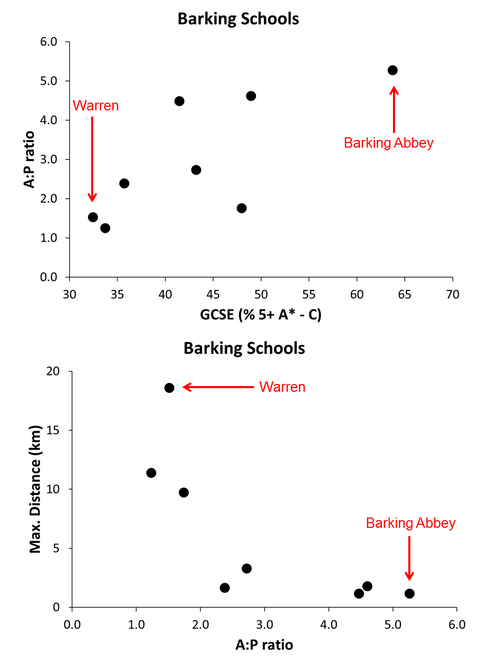
These allocation rules, combined with parent's strategies, produce patterns and relationships between schools' GCSE achievement levels, A:P ratio and the maximum distance that allocated pupils live from the school. In Barking, for example, we see in the figure below that more popular schools have higher percentages of pupils achieving five GCSE's with grades A* - C, and that these same popular schools also have the smallest maximum distances (i.e. pupils generally live very close to the school).
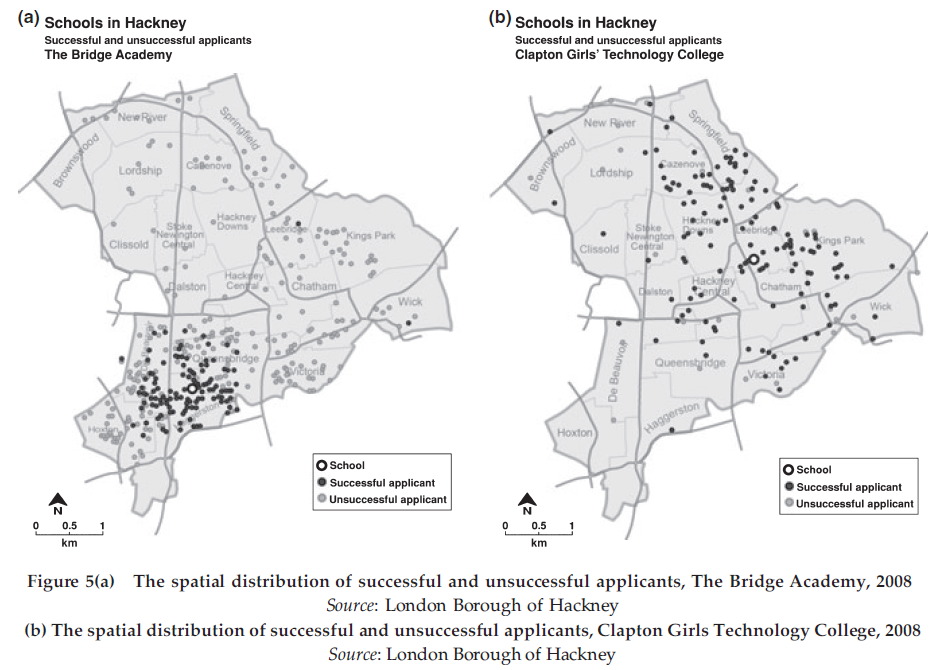
This spatial pattern can also seen when we look at maps of the locations of successful and unsuccessful applicants to popular and less popular schools in Hackney. For example, looking at the figure below (found in Hamnett and Butler 2011) we can see how successful applicants to The Bridge Academy (a popular school) are more tightly clustered around the it than those for Clapton Girls' Technology College (not such a popular school).
The geography of this school allocation policy, combined with differences in parents’ circumstances, suggests this issue is a prime candidate for study using agent-based modelling. Agent-based simulation modelling might be useful here because it provides a means to represent interactions between individual actors with different attributes (in this case schools and parents) across space and time. Once the simulation model structure (e.g. rules of interactions between agents) has been established, it can then be used to examine the potential effects of things like opening or closing schools (i.e. changes in external conditions) or changes in school allocation policy rules or parents’ application strategies (i.e. internal model relationships and rules).
I developed an initial 'model' as a proof of concept and which you can try out yourself. Things have progressed from that proof of concept model, and the model now represents changes in cohorts of school applicants and pupils through time, including the potential for parents to move house to be more likely to get their child into a desired school.
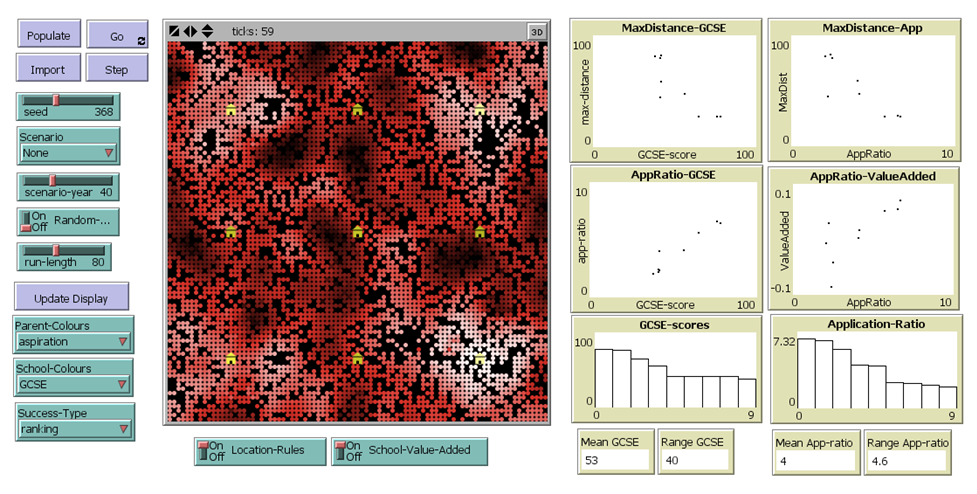
In the seminar with the Department of Education guys I presented some ouput from the recent modelling. I showed how the abstract model with relatively few and simple assumptions can start from random conditions to reproduce empirical spatial patterns in school applications and attainment outcomes like those described above (see the figure below)
I also presented early results from using the simulation model to explore implications of potential policy alternatives (such as closing failing schools). These ideas were generally welcomed in the seminar but there were some interesting questions about the what the model assumptions might entail for maintaining existing policy assumptions and intentions (what we might term the rhetoric of modelling).
I'm exploring some of these questions now, including for example issues of how we define a 'good' school and how parents' school application strategies might change as allocation rules change. These will feed into a research manuscript that I'll continue to work on with Chris and Tim.
These last few days I've been up in Edinburgh visiting folks at the Forestry Commission's Northern Research Station to discuss the socio-ecological modelling of potential woodland creation I've been working on recently. I also got to talk with Derek Robinson at the University of Edinburgh about some of these issues. Everyone seemed interested in what I've been doing, particularly with the ideas I've been bouncing around relating to the work Burton and Wilson have been doing on post-productivist farmer self-identities, how these self-identities might change, how they might influence adoption of woodland planting and how we might model that. For example, I think an agent-based simulation approach might be particularly useful for exploring what Burton and Wilson term the '‘temporal discordance’ in the transition towards a post-productivist agricultural regime". And I also think there's potential to tie it in with work like my former CSIS colleague Xiaodong Chen has been doing using agent-based approaches to model the effects of social norms on enrollment in payments for ecosystem services (such as woodland creation).
I was away on holiday for a couple of weeks after the RGS. On returning, I've been preparing for King's Geography tutorials with the incoming first year undergraduates. The small groups we'll be working will allow us to discuss and explore critical thinking and techniques about issues and questions in physical geography. Looking forward a busy autumn term!
The Leverhulme Trust makes awards in support of research and education with special emphasis on original and significant research that aims to remove barriers between traditional disciplines. Their Early Career Fellowships are awarded across all disciplines and in 2010 approximately 70 were expected to be awarded to individuals to hold at universities in the UK. Given the emphasis on original, significant and cross-disciplinary research made by the Trust I looked for something that matched my research skills in coupled human and natural systems modelling but that pushed work in that area in a new direction. I thought back to the ideas about model narratives I have previously explored with David O'Sullivan and George Perry (but have not worked on since then) and Bill Cronon's plenary address at the Royal Geographical Society in 2006 on the need for 'sustainable narratives'. With that in mind, and given the UK Forestry and Climate change report I had been reading, I decided to make a pitch for a project that would explore how narratives from the use of models could help individuals identify how local actions transcend scales to mitigate global climate change in the context of the anticipated woodland planting that will be ongoing in the UK in future years. It proved to be a successful pitch!
I'm sure I will blog plenty more about the project in the future, so for now I will just leave you with the proposal rationale (below). I'm looking forward to getting to work on this when I get back to London, but before that there's plenty more things to get done on the Michigan forest landscape ecological-economic modelling.
Model narratives for climate change mitigation The abstract, vast, and systemic narratives that dominate the issue of global climate change do little to illustrate to individuals and groups how their actions might contribute to mitigate the effects of what is often framed as a global problem (Cronon 2006). Ways to improve the ability of individuals and groups to identify how their local actions transcend scales to mitigate global climate change are needed. In this research I will explore how narratives produced from computer simulation models that represent individuals’ actions can provide people with insights into how their behaviour affects system properties at a larger scale. Although the narrative properties of simulation models have been highlighted (O’Sullivan 2004), the use of models to develop localised narratives of climate change which emphasise individual agency has yet to be explored. Confronting individuals with these narratives will also help researchers reveal important underlying, and possibly implicitly held, assumptions that influence choices and behaviour.
This research will address the following general questions:
How can computer simulation models be better used to reveal to individuals how their local actions can contribute to global environmental issues such as Climate Change Mitigation (CCM)?
What are the narrative properties of simulation models and how can they be exploited to help individuals find meaning about their actions as they relate to global climate change?
By using simulation tools to spur reflection what can we learn about the factors influencing individuals’ choices and behaviour with regards CCM options?
Answering these questions will require a uniquely interdisciplinary research approach that spans the physical sciences, social sciences and humanities. Such ground-breaking, boundary-crossing work is necessary if we are to re-connect the physical sciences with the publics they intend to benefit and find solutions to large-scale and pressing environmental problems. For example, one of the key findings from a recent report by the National Assessment of UK Forestry and Climate Change Steering Group (Read et al. 2009) was that “[t]he extent to which the potential for additional [greenhouse gas] emissions abatement through tree planting is realized … will be determined in large part by economic forces and society’s attitudes rather than by scientific and technical issues alone” (p.xvii). The report also argued the need “to better understand and consider the role of different influences affecting choices and behaviour. Without the appropriate emotional, cultural or psychological disposition, information will make no difference.” (p.210). Narratives based on scientific understanding which portray how individuals can make a difference to large-scale, diffuse environmental issues will be important for fostering such a disposition. Simulation models – quantitative representations of reality which provide a means to logically examine how high-level and large-scale patterns are generated by lower-level and smaller-scale processes and events – have the potential to contribute to the construction of these narratives.
As I mentioned in a tweet earlier this week, Prof. Ken Frank was 'visiting' CSIS this week. Ken studies organizational change and innovation using, amongst other methods, Social Network Analysis (SNA). SNA examines how the structure of ties between people affects individuals' behaviour, at how social network structure and composition influences the social norms of a group, and how resources (for example, of information) flow through a social network. This week Ken organised a couple of seminars on the use of SNA to investigate natural resource decision-making (for example, in small-scale fisheries) and I joined a workshop he ran on how we actually go about doing SNA, learning about software like p2 and KliqueFinder. Ken showed us the two main models; the selection model and the influence model. The former addresses network formation and examines individuals' networks and how they chose it. The latter examines how individuals are influenced by the people in their network and the consequences for their behaviour. As an example of how SNA might be used, take a look at this executive summary [pdf] of the thesis of a recent graduate students from MSU Fisheries and Wildlife.
On Friday, after having been introduced through the week to what SNA is, I got to chat with Ken about how it might relate to the agricultural decision-making modelling I did during my PhD. In my agent-based model I used a spatial neighbourhood rule to represent the influence of social norms (i.e. whether a farmer is 'traditional' or 'commercial' in my categories). However, the social network of farmers is not solely determined by spatial relationshps - farmers have kinship ties and might meet other individuals at the market or in the local cerveceria. We discussed how I might be able to use SNA to better represent the influences of other farmers on an indiviuals' decision-making in my model. I don't have the network data needed to do this right now but it's something to think about for the future.
If I'd been more aware of SNA previously I may have incorporated some discussion of it into the book chapter I re-wrote recently for Environmental Modelling. In that chapter I focused on the increasing importance of behavioural economics for investigating and modelling the relationships between human activity and the environment. SNA is certainy something to add to the toolbox and seems to be on the rise in natural resources research. Something else I missed whilst working on re-writing that that chapter was the importance of behavioural economics to David Cameron's 'Big Society' idea. He seems to be aware of the lessons we've started learning from things like social network analysis and behavioural economics - now he's in charge maybe we'll start seeing some direct application of those lessons to UK public policy.
This week I went to a seminar presented by Dr Richard Bawden of the Systemic Development Institute, Australia. This was the first event in MSU's “conversation about our food future”. It turned out to be much more interesting than I had hoped; Bawden is an engaging and charismatic speaker who presented a thoughtful perspective on what he termed 'The Omnivores' Trifecta': Agriculture, Food and Health and the Systemic Relationships between them. He covered a hearty spread of ideas, so I'll recap his most interesting points in bite-sized pieces:
i) Bawden suggested that Agriculture, Food and Health (A-F-H) when considered separately are not a system. But by understanding each as a discourse (i.e. as a subject for "formal discussion of debate") they become viewed in a systemic perspective.
ii) At the intersection of these three subjects are four very important (sub-)discourses which Bawden termed the "engagement discourse subsystem". These are: business, lay citizens, governance, and experts.
iii) Bawden proposed that it is the profound differences in episteme (worldview) between these discourse 'subsystems' that are at the heart of the majority of the conflicts across the A-F-H system and the environment in which it is situated.
iv) These epistemic differences are so profound as to be polemic. Bawden bemoaned this fact and highlighted that "Dialectic yields to Polemic". He emphasised that dialectics are the only way forward to forge a world in common and that polemics prevent deliberation, debate and kill democracy.
v) To illustrate these points Bawden used the case of Australian agriculture since the mid-20th century. He described this case as being characteristic of many messy, wicked problems and argued that reductionist science alone was insufficient to bring resolution (and hence is why he founded the Systemic Development Institute). During this argument he quoted Beck but questioned whether we have reached second modernity. Bawden argued that the "culture of technical control" still prevails within current modernist society has an episteme that privileges fact over value, analysis over synthesis, individualism over communalism, teaching over learning and productionism over sustainablism.
vi) On these last two dichotomies, Bawden suggested that the question of what is to be sustained (and therefore what sustainability is) is a moral question not a technical one.
vii) He proposed that higher education is about learning differently not learning more; the ability to look the world and make sense of it for oneself (and then take action in response) is what characterises a good education. Awareness of the presence of different worldviews is key to this ability. Furthermore, Bawden argued that the complete learner will be prepared to enter a form of learning that the academy is currently unable to provide because it is too reductionist. This learning would require critical reflection of one's own worldview, as Jack Mezirow has proposed.
viii) Bawden then presented the diagram that synthesises his message (see below). This diagram describes the "integrated process of the critical learning system" and shows how perceiving, understanding, planning and acting are connected within our rational experience of the world and how they are linked to the intuitive facets of learning.
Quite the feast of ideas eh? I'm still digesting them and might be for a while. But the key message I take away from this is a post-normal one; in learning about human-environment interactions and to solve current wicked problems, inter-epistemic as well as inter-disciplinary work will be needed. Although different scientific disciplines such as ecology, biology, and chemistry have different terminology and conventions, they share a worldview - the one that favours facts over values and aims to subsume empirical observations into universal laws and theories. Other worldviews are available. Inter-epistemic human-environment study would seek to cross the boundaries between worldviews, recognize that reductionist science is only one way to understand the world and is unlikely provide complete answers to wicked problems, and emphasise dialectics over polemics.
A while back I wrote about how it takes all sorts to make a world and why we need to account for those different sorts in our models of it. One of the things that I highlighted in that post was the need for mainstream economics to acknowledge and use more of the findings from behavioural economists.
One of the examples I used in the draft of the book chapter I have been writing for the second edition of Wainwright and Mulligan's Environmental Modelling was the paper by Tversky and Kahneman, The Framing of Decisions and the Psychology of Choice. They showed how the way in which a problem is framed can influence human decision-making and causes problems for rational choice theory. In one experiment Tversky and Kahneman asked people if they would buy a $10 ticket on arriving at the theatre when finding themselves in two different situations:
i) they find they have lost $10 on the way to the theatre, ii) they find they have lost their pre-paid $10 ticket.
In both situations the person has lost the value of the ticket ($10) and under neoclassical economic assumptions should behave the same when deciding whether to buy a ticket when arriving at the theatre. However, Tversky and Kahneman found that people were more likely to buy a ticket in the first situation (88%) than buying a (replacement) ticket in the second (46%). They suggest this behaviour is due to human 'psychological accounting', in which we mentally allocate resources to different purposes. In this case people are less willing to spend money again on something they have already allocated to their 'entertainment account' than if they have lost money which they allocate to their 'general expenses account'.
More recently, Galinsky and colleagues examined how someone else's irrational thought processes can influence our own decision-making. In their study they asked college students to take over decision-making for a fictitious person they had never met (the students were unaware the person was fictitious).
In one experiment, the volunteers watched the following scenario play out via text on a computer screen: the fictitious decision-maker tried to outbid another person for a prize of 356 points, which equaled $4.45 in real money. The decision-maker started out with 360 points, and every time the other bidder upped the ante by 40 points, the decision-maker followed suit. Volunteers were told that once the decision-maker bid over 356 points, he or she would begin to lose some of the $12 payment for participating in the study.
When the fictitious decision-maker neared this threshold, the volunteers were asked to take over bidding. Objectively, the volunteers should have realized that - like the person who makes a bad investment in a 'fixer-upper' - the decision-maker would keep throwing good money after bad. But the volunteers who felt an identification with the fictitious player (i.e., those told by the researchers that they shared the same month of birth or year in school) made almost 60% more bids and were more likely to lose money than those who didn't feel a connection.
Are we really surprised that neoclassical economic models often fall down? Accounting for seemingly irrational human behaviour may make the representation of human decision-making more difficult, but increasingly it seems irrational not to do so.
This week I discovered a new blog that looks worth following for anyone interested in human-environment interactions, sustainability, or CHANS. The Global Change blog intends to explore big questions about society and environmental change, such as:
How do personal choices and values play a role in this conversation?
What do the natural sciences have to say about the way our world is changing?
What do the social sciences and humanities have to say about the ways that the social and the cultural intersect with questions surrounding environment?
How can we address environmental and social challenges at the same time?
How is environmentalism changing in response to these pressures?
What’s the role of higher education in facilitating sustainability and environmental literacy?
So far the blog has posted a mix of thoughtful original writing (for example on reasons why people don't engage climate change) and brief highlights of other work. Hope they keep it coming!
Neoclassical economics, both its assumptions and its ability to forecast future economic activity, has been taking a bit of a panning recently. Back near the start of this most recent economic downturn, Jean-Philippe Bouchard argued that neoclassical economists need to develop more pragmatic and realistic representations of what actually happens in ‘wild’ and messy free markets. And at the start of this year I highlighted how Niall Ferguson has stressed the importance of considering history in economic markets and decision-making. In both cases the criticism is that some economists have been blinded by the beauty of their elegant models and have failed to see where their assumptions and idealizations fail to match what's happening in the real world. Most recently, Paul Krugman argued that ‘flaws-and-frictions economics’ (emphasizing imperfect decision-making and rejecting ideas of a perfectly free ‘friction-less’ market) must become more important. Krugman ('friend' of Niall Ferguson) suggests that mainstream economics needs to become more 'behavioural', and follow the lead of the behavioural economists that incorporate social, cognitive and emotional factors into their analyses of human decision-making.
The view from the Nature editors on all this is that in the future agent-based modelling will be an important tool to inform economic policy. In many ways agent-based modelling is very well suited to build more 'behaviour' into economics. For example, agent-based modelling provides the ability to represent several types of agent each with their own rules for decision-making, potentially based on their own life-histories and circumstances (this in contrast to the single perfectly rational 'representative agent' of neoclassical economics). Farmer and Foley, in their opinon piece of the same issue of Nature, are keen:
"Agent-based models potentially present a way to model the financial economy as a complex system, as Keynes attempted to do, while taking human adaptation and learning into account, as Lucas advocated. Such models allow for the creation of a kind of virtual universe, in which many players can act in complex — and realistic — ways. ... To make agent-based modelling useful we must proceed systematically, avoiding arbitrary assumptions, carefully grounding and testing each piece of the model against reality and introducing additional complexity only when it is needed. Done right, the agent-based method can provide an unprecedented understanding of the emergent properties of interacting parts in complex circumstances where intuition fails."
At the very least, our agent-based models need to improve upon the homogenizing assumptions of neoclassical economics. It takes all sorts to make a world — we need to do a better job of accounting for those different sorts in our models of it.
What is the point... of social simulation modelling?
Previously, I mentioned a thread on SIMSOC initiated by Scott Moss. He asked 'Does anyone know of a correct, real-time, [agent] model-based, policy-impact forecast?. Following on to the responses to that question, earlier this week he started a new thread entitled 'What's the Point?:
"We already know that economic recessions and recoveries have probably never been forecast correctly -- at least no counter-examples have been offered. Similarly, no financial market crashes or recoveries or significant shifts in market shares have ever, as far as we know, been forecast correctly in real time.
I believe that social simulation modelling is useful for reasons I have been exploring in publications for a number of years. But I also recognise that my beliefs are not widely held.
So I would be interested to know why other modellers think that modelling is useful or, if not useful, why they do it."
After reading others' responses I decided to reply with my own view:
"For me prediction of the future is only one facet of modelling (whether agent-based or any other kind) and not necessarily the primary use, especially with regards policy modelling. This view stems party from the philosophical difficulties outlined by Oreskes et al. (1994), amongst others. I agree with Mike that the field is still in the early stages of development, but I'm less confident about ever being able to precisely predict future systems states in the open systems of the 'real world'. As Pablo suggested, if we are to predict the future the inherent uncertainties will be best highlighted and accounted for by ensuring predictions are tied to a probability."
I also highlighted the reasons offered by Epstein and outlined a couple of other reasons I think ABM are useful.
There was a brief response to mine then and then another, more assertive, response that (I think) highlights a common confusion of the different uses of prediction in modelling:
"If models of economic policy are fundamentally unable to at some point predict the effects of policy -- that is, to in some measure predict the future -- then, to be blunt, what good are they? If they are unable to be predictive then they have no empirical, practical, or theoretical value. What's left? I ask that in all seriousness.
Referring to Epstein's article, if a model is not sufficiently grounded to show predictive power (a necessary condition of scientific results), then how can it be said to have any explanatory power? Without prediction as a stringent filter, any amount of explanation from a model becomes equivalent to a "just so" story, at worst giving old suppositions the unearned weight of observation, and at best hitting unknowably close to the mark by accident. To put that differently, if I have a model that provides a neat and tidy explanation of some social phenomena, and yet that model does not successfully replicate (and thus predict) real-world results to any degree, then we have no way of knowing if it is more accurate as an explanation than "the stars made it happen" or any other pseudo-scientific explanation. Explanations abound; we have never been short of them. Those that can be cross-checked in a predictive fashion against hard reality are those that have enduring value.
...
But the difficulty of creating even probabalistically predictive models, and the relative infancy of our knowledge of models and how they correspond to real-world phenomena, should not lead us into denying the need for prediction, nor into self-justification in the face of these difficulties. Rather than a scholarly "the dog ate my homework," let's acknowledge where we are, and maintain our standards of what modeling needs to do to be effective and valuable in any practical or theoretical way. Lowering the bar (we can "train practitioners" and "discipline policy dialogue" even if we have no way of showing that any one model is better than another) does not help the cause of agent-based modeling in the long run.
I felt this required a response - it seemed to me that difference between logical prediction and temporal prediction was being missed:
"In my earlier post I wrote: "I'm less confident about ever being able to precisely predict future systems states in the open systems of the 'real world'". I was careful about how I worded this [more careful than ensuring correct formatting of the post it seems - my original post is below in a more human-readable format] and maybe some clarification in the light of Mike's comments would be useful. Here goes...
Precisely predicting the future state of an 'open' system at a particular instance in time does not imply we have explained or understand it (due to the philosophical issues of affirming the consequent, equifinality, underdetermination, etc.). To be really useful for explanation and to have enduring value model predictions of any system need to be cross-checked against hard reality *many times*, and in the case of societies probably also in many places (and should ideally be produced by models that are consistent with other theories). Producing multiple accurate predictions will be particularly tricky for things like the global economy for which only have one example (but of course will be easier where experimental replication more ogistically feasible).
My point is two-fold: 1) a single, precise prediction of a future does not really mean much with regard our understanding of an open system, 2) multiple precise predictions are more useful but will be more difficult to come by.
This doesn't necessarily mean that we will never be able to consistently predict the future of open systems (in Scott's sense of correctly forecasting of the timing and direction of change of specified indicators). I just think it's a ways off yet, that there will always be uncertainty, and that we need to deal with this uncertainty explicitly via probabilistic output from model ensembles and other methods.Rather than lowering standards, a heuristic use of models demands we think more closely about *how* we model and what information we provide to policy makers (isn't that the point of modelling policy outcomes in the end?).
Let's be clear, the heuristic use of models does not allow us to ignore the real world - it still requires us to compare our model output with empirical data. And as Mike rightly pointed out, many of Epstein's reasons to model - other than to predict - require such comparisons. However, the scientific modelling process of iteratively comparing model output with empirical data and then updating our models is a heuristic one - it does not require that precise prediction at specific point in the future is the goal before all others.
Lowering any level of standards will not help modelling - but I would argue that understanding and acknowledging the limits of using modelling in different situations in the short-term will actually help to improve standards in the long run. To develop this understanding we need to push models and modelling to their limits to find our what works, what we can do and what we can't - that includes iteratively testing the temporal predictions of models. Iteratively testing models, understanding the philosophical issues of attempting to model social systems, exploring the use of models and modelling qualitatively (as a discussant, and a communication tool, etc.) should help modellers improve the information, the recommendations, and the working relationships they have with policy-makers.
In the long run I'd argue that both modellers and policy-makers will benefit from a pragmatic and pluralistic approach to modelling - one that acknowledges there are multiple approaches and uses of models and modelling to address societal (and environmental) questions and problems, and that [possibly self evidently] in different situations different approaches will be warranted. Predicting the future should not be the only goal of modelling social (or environmental) systems and hopefully this thread will continue to throw up alternative ideas for how we can use models and the process of modelling."
Note that I didn't explicitly point out the difference between the two different uses of prediction (that Oreskes and other have previously highlighted). It took Dan Olner a couple of posts later to explicitly describe the difference:
"We need some better words to describe model purpose. I would distinguish two -
a. Forecasting (not prediction) - As Mike Sellers notes, future prediction is usually "inherently probabalistic" - we need to know whether our models can do any better than chance, and how that success tails off as time passes. Often when we talk about "prediction" this is what we mean - prediction of a more-or-less uncertain future. I can't think of a better word than forecasting.
b. Ontological prediction (OK, that's two words!) - a term from Gregor Betz, Prediction Or Prophecy (2006). He gives the example of the prediction of Neptune's existence from Newton's laws - Uranus' orbit implied that another body must exist. Betz's point is that an ontological prediction is "timeless" - the phenomenon was always there. Einstein's predictions about light bending near the sun is another: something that always happened, we just didn't think to look for it. (And doubtless Eddington wouldn't have considered *how* to look, without the theory.)
In this sense forecasting (my temporal prediction) is distinctly temporal (or spatial) and demands some statement about when (or where) an event or phenomena will occur. In contrast, ontological prediction (my logical prediction) is independent of time and/or space and is often used in closed system experiments searching for 'universal' laws. I wrote more about this in a series of blog posts I wrote a while back on the validation of models of open systems.
This discussion is ongoing on SIMSOC and Scott Moss has recently posted again suggesting a summary of the early responses:
"I think a perhaps extreme summary of the common element in the responses to my initial question (what is the point?, 9/6/09) is this:
**The point of modelling is to achieve precision as distinct from accuracy.**
That is, a model is a more or less complicated formal function relating a set of inputs clearly to a set of outputs. The formal inputs and outputs should relate unambiguously to the semantics of policy discussions or descriptions of observed social states and/or processes.
This precision has a number of virtues including the reasons for modelling listed by Josh Epstein. The reasons offered by Epstein and expressed separately by Lynne Hamill in her response to my question include the bounding and informing of policy discussions.
I find it interesting that most of my respondents do not consider accuracy to be an issue (though several believe that some empirically justified frequency or even probability distributions can be produced by models). And Epstein explicitly avoids using the term validation in the sense of confirmation that a model in some sense accurately describes its target phenomena.
So the upshot of all this is that models provide a kind of socially relevant precision. I think it is implicit in all of the responses (and the Epstein note) that, because of the precision, other people should care about the implications of our respective models. This leads to my follow-on questions:
Is precision a good enough reason for anyone to take seriously anyone else's model? If it is not a good enough reason, then what is?
And so arises the debate about the importance of accuracy over precision (but the original 'What is the point' thread continues also). In hindsight, I think it may have been more appropriate for me to use the word accurate than precise in my postings. All this debate may seem to be just semantics and navel-gazing to many people, but as I argued in my second post, understanding the underlying philosophical basis of modelling and representing reality (however we might measure or perceive it) gives us a better chance of improving models and modelling in the long run...